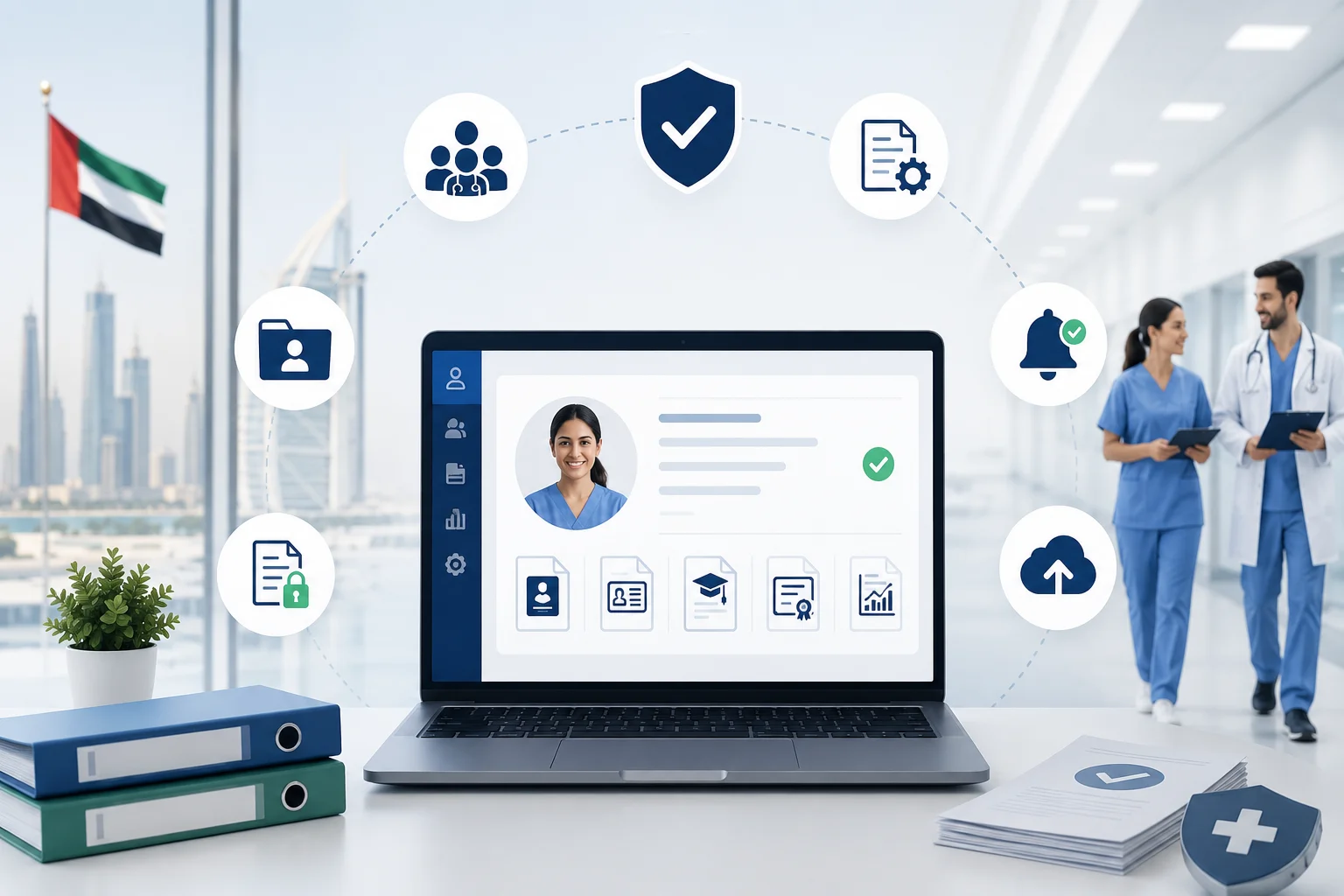
In the high stakes environment of a UAE hospital, the term integration is usually associated with clinical systems. We ensure that a patient’s lab results flow seamlessly to their electronic health record. However, as an HR compliance expert, I often ask healthcare administrators a different question. Is your employee data as integrated as your clinical data?
In many hospitals across the seven emirates, from the sprawling medical cities in Abu Dhabi to the specialized clinics in Dubai Healthcare City, HR documents are treated as static assets. They sit in isolated digital filing cabinets. When a nurse is hired, her documents sit in a recruitment folder. When she submits a tax proof, it sits in a payroll folder. When she earns a new certification, it sits in a training folder. These are data silos. In a sector where compliance is non-negotiable and audit readiness is a daily requirement, these silos create massive operational risk.
Abu Dhabi: Clinical Licensing and Document Velocity
The Department of Health (DOH) in Abu Dhabi maintains some of the most stringent requirements in the region. Hospitals must ensure that every staff member on the floor has an active license. When HR documents are integrated, this license is not just a scanned PDF. It is a live data point. A smart system allows these documents to appear exactly where they are needed. If a license is updated in the employee's profile, it is immediately visible to the rostering manager. This prevents the manual tax of cross referencing spreadsheets to ensure that the staff assigned to a shift are legally cleared to practice.
Dubai: Automated Payroll and Tax Document Bridges
Dubai’s fast paced healthcare market requires a payroll system that is as agile as its workforce. Tax season and investment declarations often lead to a document chase that consumes hundreds of administrative hours. When a hospital employee in Dubai uploads a rent receipt or an insurance policy for tax purposes, it should not just sit in a queue. An integrated platform automatically saves and categorizes these in the Document Management System (DMS) and links them directly to the payroll engine. The admin can verify the proof while processing the pay run without having to toggle between different systems. This real time connectivity reduces salary errors and ensures your financial audits remain clean.
Sharjah: Letter Generation for a Diverse Workforce
Sharjah’s medical institutions often manage a highly diverse, international workforce that frequently requires official documentation for visas, bank loans, or housing. An integrated letter generation engine allows HR to create increment letters, address proofs, or experience certificates using live system data. Because the system is integrated, these letters are automatically saved to the employee’s folder the moment they are generated. No manual typing, no copy pasting, and most importantly, no risk of mismatched data. This creates a circular ecosystem where data drives the document and the document reinforces the integrity of your records.
Ajman: Streamlining Multi Specialty Clearances
In Ajman, where many hospitals are expanding into multi specialty care, managing exit clearances and NOCs is a significant administrative burden. When a specialist leaves, the clearance process involves multiple departments including Admin, IT, Pharmacy, and HR. Linking the Exit Clearance NOC directly to the Final Settlement workflow ensures that as each department signs off digitally, the document updates in real time. This allows the Finance team to process the full and final settlement without waiting for physical papers to move across the building.
Umm Al Quwain: Centralized Visibility for Assets
Umm Al Quwain’s healthcare facilities are increasingly focusing on specialized clinical assets. Managing the documents associated with these assets such as insurance for mobile clinics or maintenance certificates for diagnostic equipment is often handled by different teams. A centralized dashboard provides visibility across all branches and assets. By linking asset documents to the employees responsible for them, you create a culture of accountability where every piece of equipment and every certification is accounted for.
Ras Al Khaimah: Automation for Training and Compliance
In Ras Al Khaimah, hospitals are investing heavily in continuous medical education (CME). This generates a constant stream of training certificates that must be filed for accreditation purposes. An integrated system ensures that when an employee completes a training module, the resulting certificate is automatically routed to their compliance folder. This ensures that during an audit, your HR team is not scrambling to find paper proofs. They are simply demonstrating a system that is always 100% audit ready.
Fujairah: Real Time Alerts and Maritime Sync
For hospitals in Fujairah, which often serve the maritime and logistics sectors, the workforce must be mobile and compliant with both healthcare and port entry regulations. API Webhooks allow for instant notifications to Slack or Microsoft Teams the moment a critical document is uploaded or is nearing expiry. This ensures that the leadership team has a bird's eye view of the workforce's readiness, preventing operational delays before they happen.
Closing the Workflow Gap: The Compliance Case
A standalone Document Management System is a silo. It requires manual effort to move files from where they are created to where they are needed. In the healthcare sector, where the cost per transaction in HR is high, this manual movement is pure waste. The most common point of data loss is the transition from Candidate to Employee. Documents like offer letters, government IDs, and academic transcripts collected during recruitment often end up lost in an inbox. Automation ensures this transition is seamless. The moment a candidate is hired, their entire recruitment folder should instantly migrate to their new profile in the core HRMS to ensure continuity and zero manual re-uploads.
The Future of Hospital HR in the UAE
As we look toward the future of healthcare administration in the Emirates, the goal is Hands Free HR. This is only possible when you have an AI-driven HR platform that understands the context of every document. Whether you are searching for a specific nurse's DHA license or generating a salary certificate for a doctor, the system should do the heavy lifting for you.
For UAE hospitals, the transition to integrated HR documents is the first step in building a truly connected data workflow. By adopting the best HRMS for hospitals in the UAE, you are not just buying software. You are investing in an ecosystem that reduces operational leakage and ensures your institution is always ready for a MOHRE or DOH audit. At Kiework, we have built this integration at a 100% completion status because we know that in a hospital, every second saved in administration is a second that can be redirected back to patient care. Don't just store your files. Connect them, and let your data be the foundation of your compliance.
