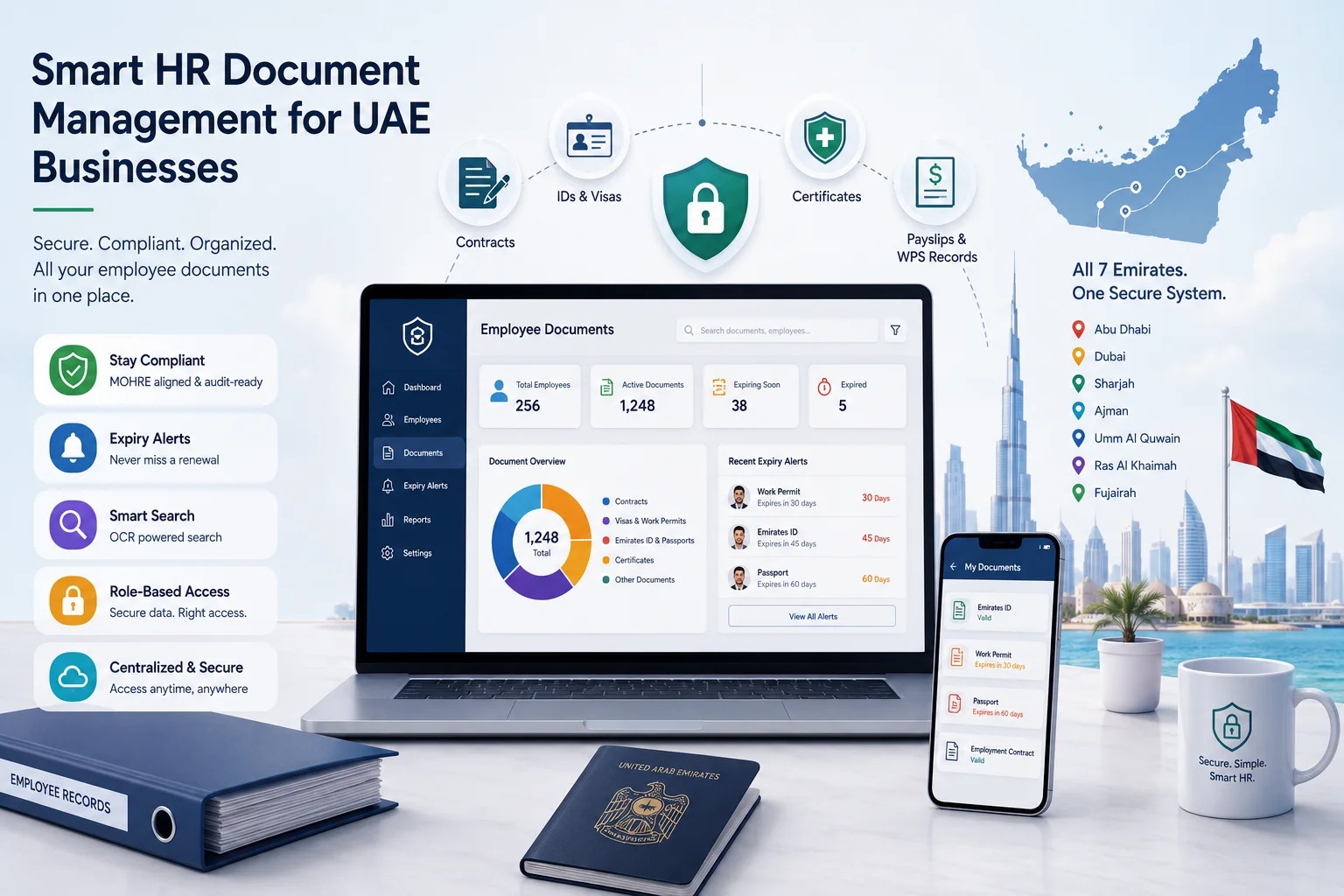
Operating a growing business in the United Arab Emirates demands a flawless approach to corporate administration. As organizations expand their operations across local free zones and competitive mainland markets, the volume of sensitive employee paperwork multiplies rapidly. Relying on loose paper folders, scattered local desktop directories, or unorganized generic cloud links introduces severe operational vulnerabilities. Missing files lead directly to unexpected operational bottlenecks, expensive late-renewal fines, and compliance exposures during unexpected regulatory inspections.
Transitioning to a secure, cloud-based centralized repository for HR documents acts as an airtight digital filing cabinet. This ensures that organizations have one central place that guarantees complete compliance with the local laws and statutes when managing employees from start to finish.
Understanding the Regulatory Landscape: Why Centralization is Mandatory
The Ministry of Human Resources and Emiratisation (MOHRE), along with federal immigration authorities, enforces strict record-retention mandates for all private sector establishments. Under current UAE labor regulations, businesses are legally obligated to maintain detailed, up-to-date employee files and labor records for a minimum of two to seven years following an employee's official service termination date.
The above-mentioned regulations make it compulsory for a compliant corporate document library to have specific key documents secured. The documents in question include MOHRE registration contracts showing split figures of basic salary and allowances, valid work permits corresponding to recognized job titles, as well as passports linked with Emirates IDs indicating visa expiration dates. Additionally, the document library is supposed to store comprehensive Wage Protection System registration details and payslip history records from SIF.
When official compliance inspectors execute routine audits or respond to labor variance flags, your HR team must provide immediate access to valid documents. A centralized repository ensures that your organization never falls victim to document retrieval lags, protecting your operational licenses from costly work permit suspensions or visa freezes.
Seamless Compliance Architecture Across All Seven Emirates
The complex nature of UAE workforce management stems from balancing unified federal labor laws with local municipal approvals, commercial trade license procedures, and distinct residency guidelines across different jurisdictions. A smart digital document repository provides tailored operational support for your corporate entities across every single emirate:
Abu Dhabi: Managing operations in the federal capital requires tracking strict security clearances, specific health insurance policies approved by the Department of Health (DoH), and localized In-Country Value (ICV) certification documentation.
Dubai: Entities balancing mainland activities with high-velocity free zones must seamlessly tie their personnel folders to distinct municipal platforms, tracking active office leases via Ejari alongside specific community work permits.
Sharjah: Businesses operating in this cultural and industrial hub manage complex manufacturing and logistical shifts, requiring localized verification records for industrial employee accommodations that align completely with municipal safety codes.
Ajman: High-density commercial centers in this emirate rely on rapid onboarding pipelines where digital registration allows companies to store clear corporate licenses and worker documents in a structured, accessible database.
Umm Al Quwain: Progressive industrial zones and trade networks demand structured record archives to help growing teams track regional work authorizations without administrative errors.
Ras Al Khaimah: Driven by booming maritime, manufacturing, and tourism sectors, enterprises here use centralized storage to audit maritime visas, specialized engineering licenses, and local hospitality clearances effortlessly.
Fujairah: Serving as a vital strategic bunkering and shipping gateway, operations here must secure unique port safety certificates, custom clearances, and multi-state transport permits within an organized employee directory.
Core Structural Features of an Advanced HR Document System
A secure, enterprise-grade digital vault goes far beyond basic online file hosting. It introduces automated tools specifically engineered to handle the modern realities of high-velocity human resources management:
1. Smart Metadata and Tagging Structures
Rather than hiding folders under many layers of subfolders, a sophisticated archive attaches dynamic metadata properties to each and every document. Some important identifiers are employee ID, document category (Onboarding, Identity, Appraisal, Exit, etc.), and expiration date. The result is that compliance managers can search the system for a certain cross-section of documents right away, such as searching for all missing NDAs and active work visas in one department.
The automated processing sequence handles ingestion directly by moving files from raw upload through an Optical Character Recognition text scan before automatically assigning the respective unique worker IDs, file categories, and statutory expiration metrics.
2. Built-In Optical Character Recognition (OCR) Technology
The PDF scans, images, and signatures from receipts become totally text-searchable. The HR department can no longer spend time opening individual files just to locate specific paragraphs or check ID numbers; all that is needed is to use the semantically intelligent search bar to crawl through the text.
3. Granular Access Controls (RBAC Engine)
A key aspect of compliance when it comes to federal data privacy regulations is the protection of PII. The use of Role-Based Access Control (RBAC) makes it possible for administrators to set up multi-level access permission controls depending on whether the person is from a specific department, has certain seniority levels, or plays certain roles. Though the employees have full self-service access that gives them the ability to see their personal information stored in personnel files using a mobile app, they cannot access any of the personal folders belonging to their colleagues.
The Operational Impact: Real-World Business Metrics
To clearly understand how moving away from manual tracking impacts a business, we can examine a standard operational baseline. Consider a standard company profile of 100 employees earning an average salary of $25 per hour, which translates to a $20,000 total daily payroll. When an organization manages records through unstructured emails, local desktops, or physical paper folders, administrative overhead drains profits through three major leakage vectors:
Category A (Professional Corporate Offices): Administrative lag from manually searching for files, chasing missing non-disclosure agreements, and re-keying onboarding profiles leaks an average of 2.5% of total payroll. This causes an operational loss of $500 per day, which adds up to a quiet deficit of $11,000 every month.
Category B (High-Volume Retail & Restaurants): High employee turnover and rapid seasonal hiring waves cause severe document lag. Manually verifying health certificates and sorting onboarding forms across multiple branches leaks 5.0% of payroll, costing companies $1,000 per day** or $22,000 every month.
Category C (Industrial Manufacturing & Logistics): Complex shift operations require tracking heavy equipment licenses, mandatory safety training certifications, and specific field clearances. Administrative gaps in managing these time-sensitive records leak 7.5% of total payroll, causing a significant drain of $1,500 per day or $33,000 every month.
Centralizing your document architecture completely eliminates this administrative lag, reducing file retrieval times by over 99% and saving teams hundreds of manual tracking hours every year.
Proactive Expiration Tracking: Eliminating Visa Fines
One of the fastest financial benefits that would accrue from the creation of a centralized database in the UAE is expiry notification. Non-renewal of documents such as Emirates ID, passports, work permits, and trade licenses may be very costly due to heavy fines from immigration and labor authorities.
Advanced data storage technology addresses this challenge by performing daily scans of the database in relation to expiration tags on the stored metadata. The automatic process of creating alerts is set up 90, 60, and 30 days ahead of the expiry period of the document. This is done in a manner that the notifications go to both the individual worker and the overseeing HR manager, thereby shifting the operation from emergency mode into systematic mode. The hierarchical process ensures that early alerts go to the specific worker while critical notifications will escalate to department heads and public relations officers of the firm.
Secure Internal Sharing Protocols
Sharing employee files over unencrypted email attachments or unsecured chat messages is a major corporate security risk. A centralized digital repository replaces these dangerous practices with an internal sharing protocol built on secure, time-bound view links.
If any finance controller or executive auditor needs to have access to certain payroll proofs or employee contracts, the administrative staff creates a secure link within the internal system. This link involves signing in through a particular platform, where the system checks whether the user has appropriate access rights. After some time frame, this link becomes invalid so that your corporate information will never be leaked out from your secured infrastructure. Every action related to viewing, editing, downloading or sharing the file is recorded with an IP address and timestamp in an audit log.
Moving to an Airtight, Future-Proof HR Core
As your business scales across the UAE, maintaining complete control over your human resource data is essential for long-term growth. Transitioning away from fragmented, manual filing methods toward an integrated, cloud-native centralized repository helps your business eliminate wage leaks, ensure flawless data integrity, and remain fully audit-ready at a moment's notice.
Protect your business infrastructure, secure your personal employee data, and build a stress-free environment for compliance audits with a modern,bank-grade digital vault engineered directly for the evolving regulatory landscape of the United Arab Emirates.
