The Indian healthcare sector is currently navigating a period of unprecedented scale and complexity. As a compliance expert, I have watched hospitals transform from localized clinics into massive, multi-city corporate entities. In this high-stakes environment, the traditional methods of managing workforce presence and asset security are no longer just inefficient (they are a liability). When we talk about "life and death" in a clinical setting, we aren't just discussing medical procedures; we are talking about the integrity of the systems that ensure the right person is in the right ward at the right time.
The combination of Biometric and RFID (Radio Frequency Identification) technology is the biggest advancement in healthcare human resources that I have seen in my career. It tackles the unique blend of legal requirements, patient safety, and operational efficiency that shapes the Indian medical landscape.
The Challenge of the 24/7 Clinical Cycle
Unlike manufacturing or retail, healthcare never sleeps. The Indian hospital environment operates on a complex rotation of three shifts, often with overlapping "on-call" duties for senior consultants. Managing this manually leads to "ghost employees" or "buddy punching," where the system shows a nurse is on duty when the ward is actually understaffed.
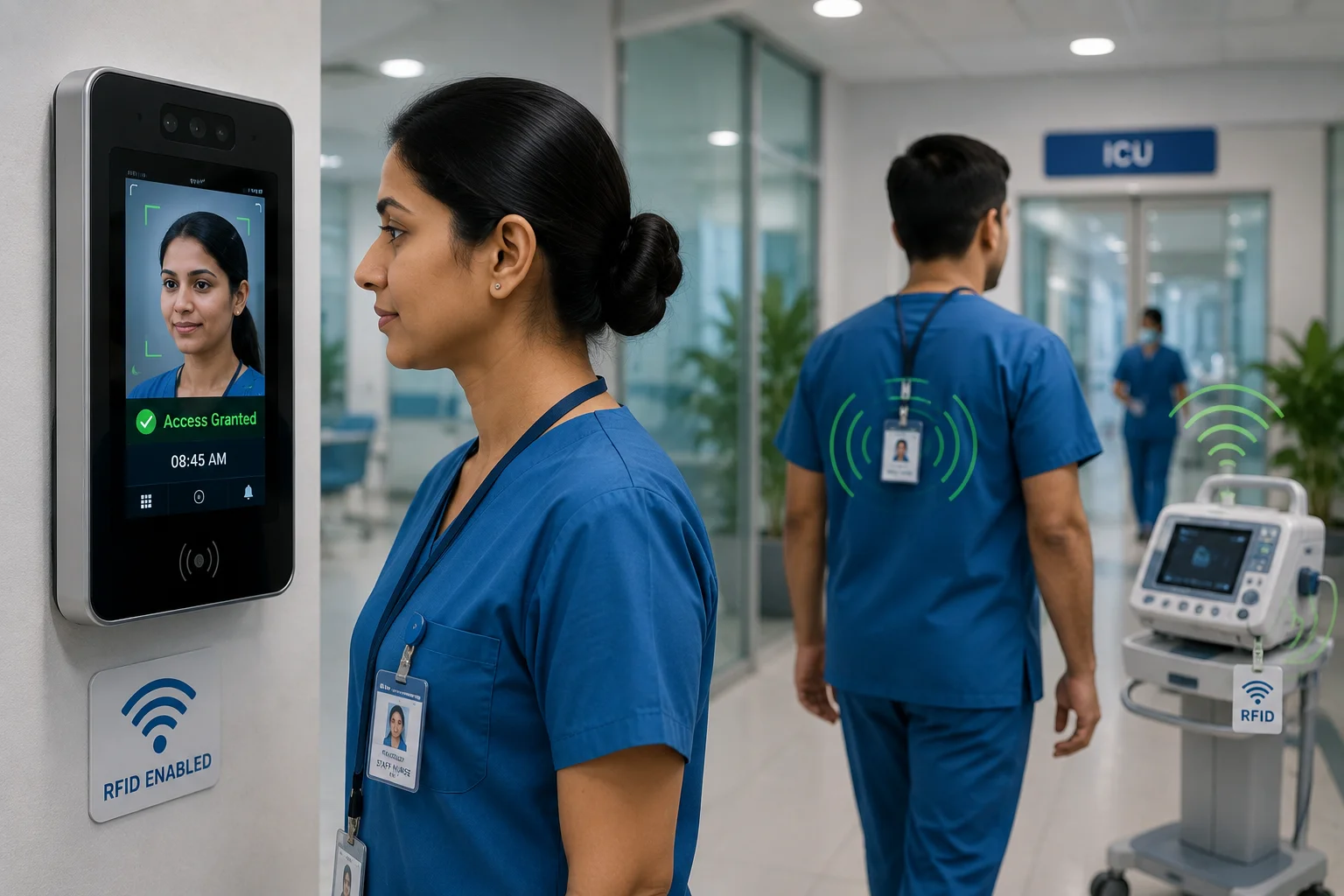
Biometric integration, specifically AI-powered facial recognition and iris scanning, eliminates identity fraud. In India, where hygiene is crucial, contactless biometrics have become the preferred option. When a doctor enters the facility, a quick scan records their presence and connects it directly to the payroll system. This ensures that every hour billed is an hour worked, offering a level of transparency that manual logs or card systems cannot achieve.
RFID: Beyond Attendance to Real-Time Location
While biometrics verify "who," RFID technology answers "where." In large Indian multi-specialty hospitals, the ability to track movement in real-time is a game-changer for both staff management and patient safety. By embedding RFID tags into staff ID badges, hospital administrators can monitor movement through sensitive zones.
If a pediatric ward requires restricted access, the RFID system acts as an invisible gatekeeper, logging exactly who entered and exited. Furthermore, during emergency "Code Blue" situations, RFID can locate the nearest available cardiologist or respiratory therapist in seconds, potentially saving lives by reducing response times that were previously wasted on overhead pages and phone calls.
Solving the Nursing Shortage through Data Integrity
India faces a significant nursing-to-patient ratio challenge. To remain compliant with healthcare accreditation standards, hospitals must prove they have adequate coverage at all times. Biometric logs provide the raw data needed for "Optimal Nurse Coverage" analytics. Through analysis of biometric information, it becomes possible to recognize trends associated with employee burnout. Whenever a particular department records that it works 12-hour shifts for six consecutive days, the computer automatically picks up this trend as a potential source of fatigue. In terms of compliance and audits, it will be much easier for the HR team to take action before an accident happens.
Statutory Compliance: PF, ESI, and the Labor Inspector
In India, statutory compliance is non-negotiable. Labor inspectors frequently audit hospital records to ensure that Provident Fund (PF) and Employee State Insurance (ESI) contributions match the actual days worked. Manual attendance registers are often the first point of failure during an audit because they are prone to back-dating and human error.
Integrated biometric systems are able to produce "audit ready" reports in just one click. In cases where the biometric record becomes the primary document for payroll processing, the threat of wage leakage and fines ceases to exist altogether. This offers "peace of mind" to hospital management in what is becoming a highly regulated environment.
Asset Security and High-Value Inventory
Hospitals house millions of dollars in portable medical equipment (from mobile X-ray units to high-end infusion pumps). In the hustle of an Indian hospital, these assets often go missing or are "hoarded" in specific departments. RFID integration allows for seamless asset tracking. By tagging equipment, the system can alert security if a piece of machinery leaves its designated floor. More importantly, it can link the movement of the asset to the person moving it (via their biometric-linked ID). This dual layer of accountability ensures that the hospital’s physical capital is protected and utilized at maximum efficiency.
Patient Safety and Restricted Zones
One of the most sensitive compliance areas in Indian healthcare is the management of restricted zones, such as the ICU, Operation Theaters, and the Pharmacy. Biometrics provide a level of security that passwords or keys never could. The fingerprint and face of the surgeon are what grant them access to the OT. This makes sure that no one other than those who have permission to enter can enter a sterile room. In the pharmacy, where the most expensive medicines are kept, a biometric access log serves as a digital paper trail.
The ROI of Digital Transformation
Many Indian hospital boards hesitate at the initial cost of Biometric and RFID hardware. However, the return on investment is visible within months. The reduction in manual administrative effort alone is massive. When HR teams no longer spend the first five days of the month reconciling attendance logs, they can focus on high-value tasks like talent development and patient experience. Furthermore, the elimination of "buddy punching" and the optimization of shift rotations typically result in a 3% to 5% reduction in total labor costs. In the thin-margin environment of healthcare, those percentages can be the difference between a struggling facility and a thriving one.
The Future is Integrated
As India strives to become a global hub for medical tourism, our backend systems must meet international standards. Patient trust is built on the foundation of institutional reliability. When a patient knows that a hospital utilizes advanced technology to manage its staff and assets, it enhances the overall brand reputation. The transition to a fully integrated environment is not just a technological shift (it is a cultural one).
It fosters a culture of accountability and precision that is essential for modern medicine. By adopting a robust biometric and RFID integration strategy within a centralized healthcare HRMS platform, Indian hospitals can ensure they are not just treating patients today, but building a compliant and efficient infrastructure for the future. In the world of healthcare, the digital pulse must be as steady as the human one.
