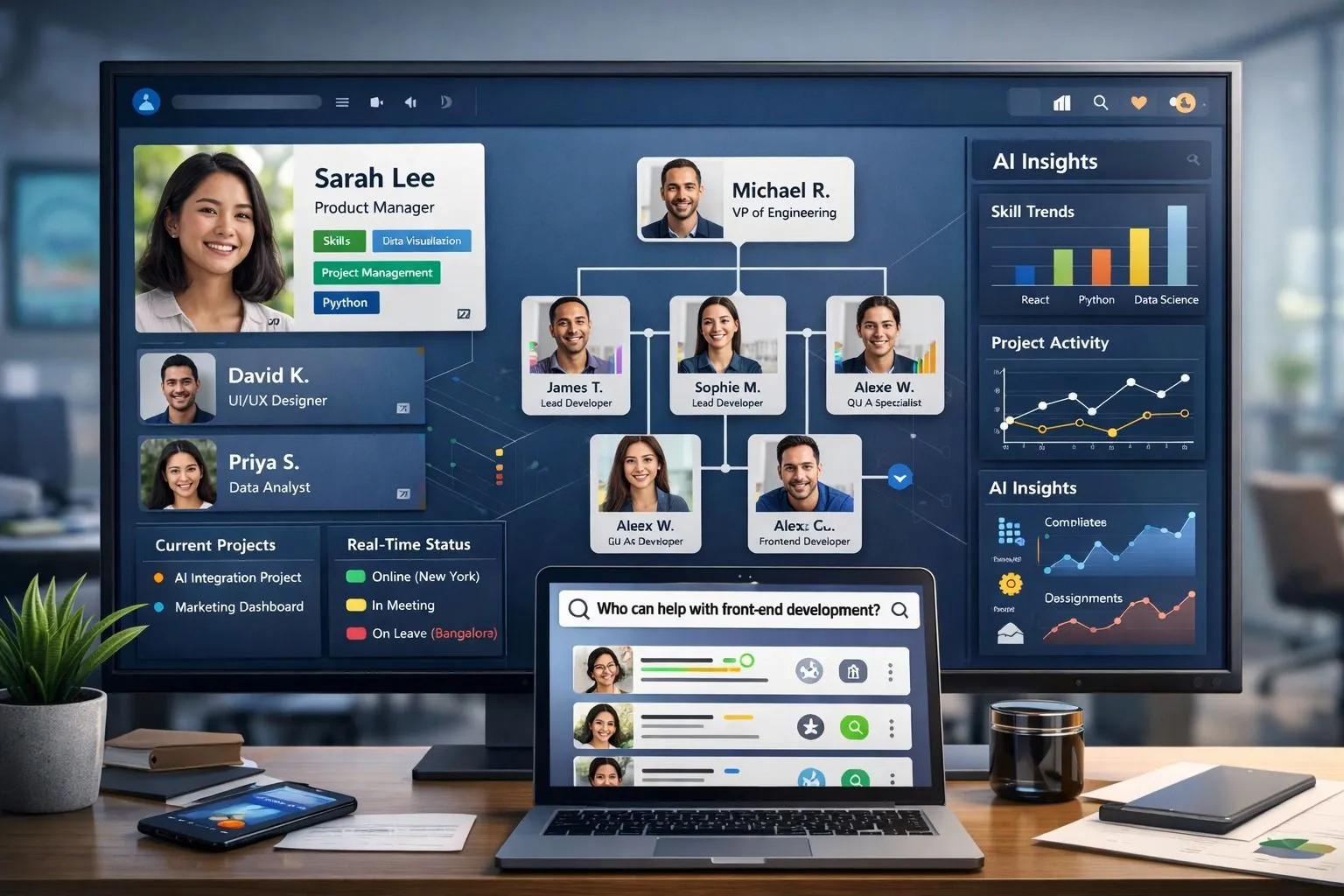
The concept of the corporate "phonebook" is dead. In today's decentralized, fast-moving work environments, a static list of names and extensions is no longer sufficient. An employee directory has evolved into the digital nervous system of an organization, a tool that facilitates cross-functional collaboration, strengthens culture, and powers operational efficiency.
Many organizations still rely on static directories without realizing how much time employees spend simply trying to locate the right expertise internally.
For a directory to be effective, it must go beyond the basics of "Name" and "Title." It must provide a multidimensional view of a person’s professional identity and current context. Here is a breakdown of the essential fields every modern directory needs and the role of artificial intelligence in maintaining them.
Beyond the Basics: Essential Modern Fields
According to research and global standards set by the International Labour Organization (ILO), fostering transparent communication and social dialogue within a workplace is a key pillar of "decent work" and organizational sustainability. An employee directory software that highlights more than just a reporting line is often the first step in creating that transparent environment.
In many organizations, clarity around roles and expertise naturally reduces communication delays and improves collaboration across teams.
1. Skills and Competencies
In a skills-based economy, the directory is the primary tool for resource allocation. Knowing that a team member in the Finance department also happens to be an expert in Data Visualization (Tableau) or Python allows leadership to tap into internal talent for special projects. This transparency prevents the "silo effect" where expertise remains hidden within specific departments.
In practical workplace situations, hidden skills often surface only during urgent deadlines, which shows how much internal capability organizations sometimes overlook.
2. Inclusiveness
Inclusion is a core tenet of modern workplace culture. It is an operational necessity that ensures respectful communication across global teams. When identity is clear from the first interaction, it reduces friction and builds a culture of psychological safety.
Interestingly, small clarity in identity and communication preferences at the beginning often prevents larger misunderstandings later in collaborative projects.
3. Current Projects and History
Visibility into what someone is actually doing is often more valuable than their job description. A "Current Projects" field allows colleagues to see the context of someone’s workload. If a Product Manager is looking for feedback on a specific feature, they can search for anyone currently assigned to a related "sprint" or "initiative," rather than guessing who is involved.
What often gets overlooked is how frequently organizations lose valuable knowledge when project experience is not properly documented or shared.
4. Time Zones and Real-Time Status
With the rise of distributed work, the "Where" is often less important than the "When." A modern directory must display local time zones and integrate with leave management modules to show real-time status. Knowing a colleague is "Online" in New York or "On Leave" in Bangalore prevents the frustration of "ghosted" messages and allows for better synchronous meeting planning.
Anyone working across multiple regions understands how unclear availability can slow conversations and decision-making.
How AI Solves the "Stale Data" Problem
The biggest challenge with any directory is data decay. Historically, directories relied on employees manually updating their bios, a task that almost always falls to the bottom of the priority list.
Anyone who has worked closely with HR or administrative systems knows profile updates usually happen only during audits, reviews, or major role changes.
Artificial Intelligence has transformed this from a manual burden into an automated background process.
Dynamic Skill Tagging
AI doesn't wait for an employee to list a skill. By analyzing project descriptions, performance reviews, and even public contributions (like GitHub or internal wikis), AI can suggest new skill tags.
For example, if an employee successfully manages a complex integration, the AI can suggest adding "System Architecture" to their profile, which the employee can then approve with a single click.
This also helps organizations maintain a continuously evolving skills inventory without placing additional workload on employees.
Semantic Search and Intent
Traditional directories rely on exact keyword matches. If you search for "React," you get people with "React" in their title. AI-powered directories use Natural Language Processing (NLP) to understand intent.
A search for "who can help me with front-end development?" will surface React developers, even if the specific word "front-end" isn't on their profile.
What happens when employees cannot quickly identify the right expert inside their own organization? In many cases, collaboration slows down simply because knowledge is harder to locate.
Automated Org-Chart Mapping
In a rapidly scaling company, reporting lines change frequently. AI-driven systems sync directly with core HRMS data to visualize these changes instantly. When a promotion or department transfer occurs, the interactive Org Chart updates in real-time, ensuring new hires always have an accurate map of the hierarchy.
From a day-to-day operational perspective, accurate org structures reduce confusion and help employees navigate responsibilities more confidently.
The Digital Backbone of Productivity
A well-maintained directory acts as an accelerator for onboarding. Instead of spending the first week asking "who handles X?", a new hire can use advanced filters to find the right person instantly. This self-service model reduces the administrative burden on HR and empowers employees to find the answers they need to do their jobs.
Ultimately, the directory is about visibility. When employees can see the skills, time zones, and contributions of their peers, the organization moves from a collection of individuals to a coherent, collaborative unit.
At Kiework, we have built a directory that functions as a "single source of truth." We ensure that your employee records are not just secure and searchable, but intelligent. By automating the data quality process and providing 360-degree profiles, we help organizations stay connected, regardless of how fast they scale.
