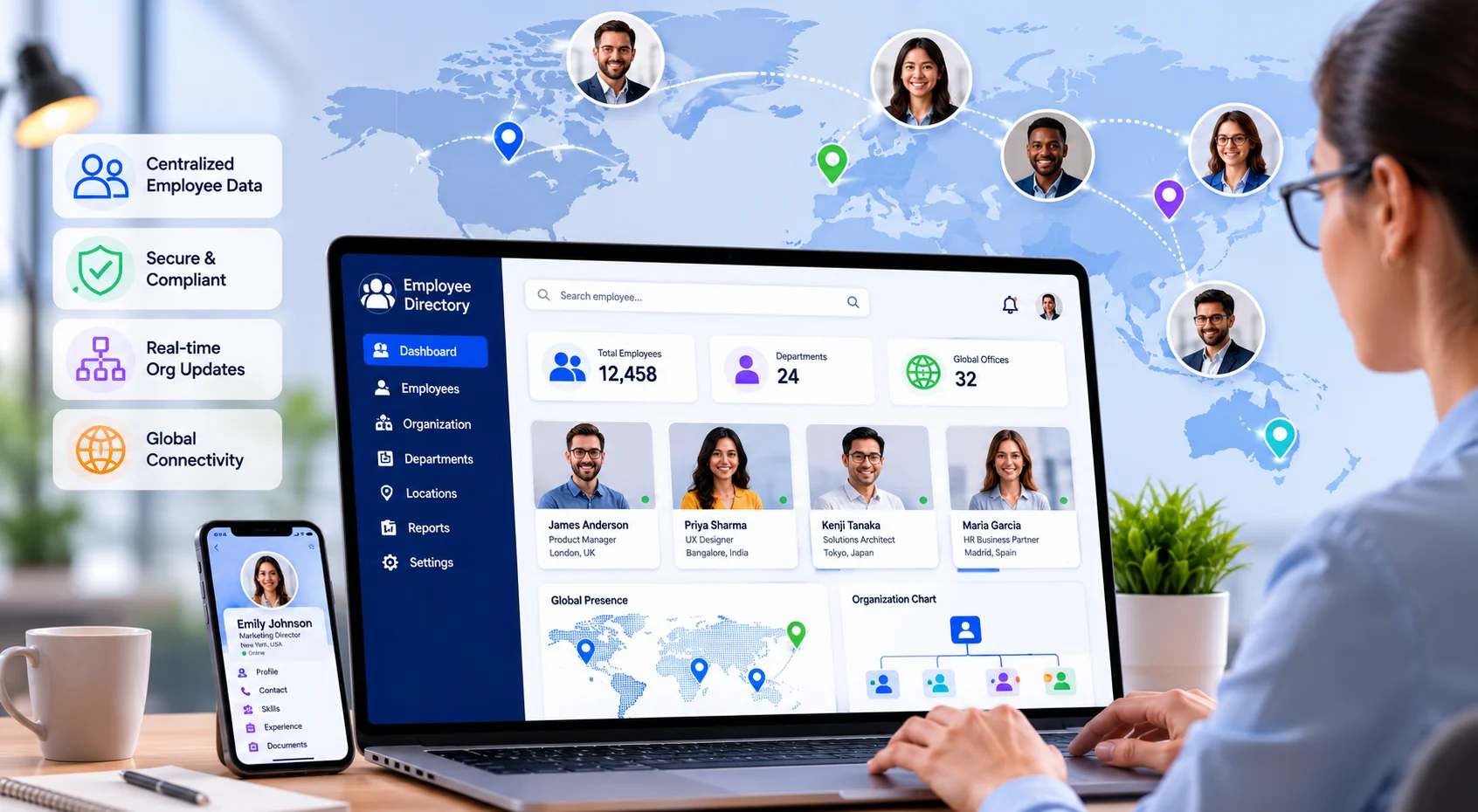
In an era defined by distributed teams, cross-border collaborations, and hybrid working models, the ability to maintain a single, trusted source of workforce truth is a major factor in driving organizational agility. As enterprises scale past regional borders and open offices across different continents, managing core employee profiles, reporting hierarchies, and sensitive professional data becomes increasingly complex. When human resource records are scattered across disconnected spreadsheets, local network folders, and siloed regional software, data fragmentation quietly erodes operational efficiency and stalls company growth.
For any current-day organization to effectively manage their talent pool, it is necessary to leave behind the old, stagnant databases and opt for active corporate directories which form the basis of all people management processes. In today’s world, the creation of an interactive directory is not simply about having contact information but also about connecting talent, making administrative approvals faster, and protecting personnel files using bank-grade data security technology.
The primary administrative challenge for global operations is the delay caused by disconnected human resource systems. When a team member changes their role, updates their personal details, or shifts to a new international office, that information must be updated manually across multiple separate systems—including payroll ledgers, active IT communication tools, and local compliance trackers. This manual maintenance consumes hundreds of productive hours and increases the likelihood of data entry discrepancies.
These data disconnects often result in minor errors that disrupt daily operations, such as incorrect internal email routings or mismatched management hierarchies during critical project approval cycles. For example, if a software engineer based in London cannot quickly identify and connect with a product specialist in Tokyo due to an outdated directory, development velocity drops immediately, delaying critical project milestones.
The shift toward a cloud-based centralized system would overcome such barriers to effective communication entirely. This is due to the fact that when employees get intuitive and easy-to-use services through web browsers or mobile apps, then members of a team will be able to edit their own work history, contact details, and skills. Changes made by employees will be instantly replicated in all organizational networks around the globe.
Beyond basic profile storage, an advanced directory engine functions as a powerful tool for global resource management. Utilizing multi-dimensional metadata tagging allows project managers and talent acquisition teams to filter the entire global workforce instantly by specific technical skills, localized certifications, language proficiencies, or exact physical locations. This capability is invaluable when assembling agile, cross-functional teams to tackle complex, high-priority international assignments.
For example, instead of sending endless group emails or waiting days for regional human resource leads to supply resumes, a project director can search the centralized cloud system for an executive who holds a specific certification, speaks fluent German, and is currently based in a particular time zone. The system surfaces matching profiles instantly, displaying real-time availability and reporting structures, which drastically reduces internal resource allocation times from several days down to just a few clicks.
In addition, there is an automatically created corporate organizational chart that updates its reporting connections depending on current personnel data. Such a chart will help remote workers instantly understand how the hierarchy in the company functions and what links exist between departments, creating an open culture of collaboration within the organization.
As data privacy regulations tighten worldwide, protecting employee Personally Identifiable Information (PII) is a top priority for corporate leadership. Distributing personnel reports, passport scans, or salary details via insecure email threads or open shared drives exposes companies to severe security breaches and massive compliance penalties from international data protection boards.
A modern directory system resolves these risks by embedding role-based access control engines directly into the core database layer. This ensures that sensitive documents, background verifications, and financial details are visible only to authorized personnel, while remaining completely hidden from unauthorized peers. Every single data interaction including who viewed, modified, or downloaded a profile is captured inside an unalterable audit log, giving compliance leads complete transparency and peace of mind. By establishing absolute data integrity across your global infrastructure, company executives can confidently scale international operations without running into data fragmentation or security risks. Unifying your people systems under a secure digital core protects your margins and gives your talent acquisition teams a distinct edge when hiring across international borders.
Building an agile, highly responsive global workplace requires connecting your core employee directory with advanced recruitment and performance frameworks. To transform your talent acquisition pipelines and discover how automated sourcing tools can dramatically lower candidate acquisition costs while building a high-ROI hiring pipeline, you can take the time to explore our corporate applicant tracking systems. To learn how real-time competency mapping and continuous milestone evaluations can be used to optimize internal team design and plan clear career progression paths for your teams, choose to browse our performance development solutions for comprehensive insights. To secure a unified system of truth that scales seamlessly alongside your business, implement our centralized employee directory software to drive maximum operational velocity today.
