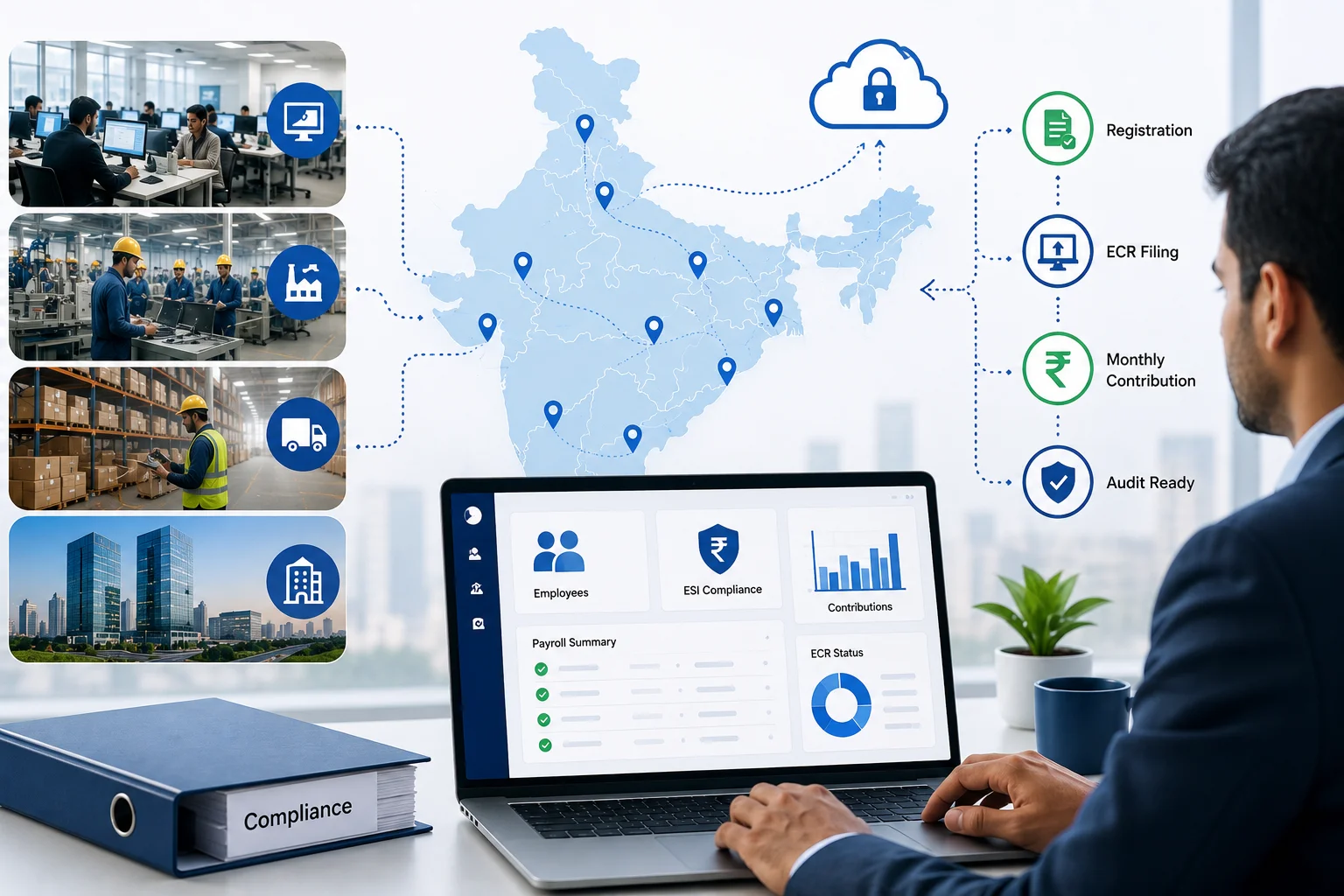
Operating a scaled corporate infrastructure across India’s vast industrial, commercial, and technological corridors requires a rigorous, multi-layered approach to statutory employee benefits. Among the various statutory frameworks governing workforce compensation, the Employees' State Insurance (ESI) Act of 1948 stands out as one of the most operationally demanding. Designed to provide comprehensive socio-economic protection to workers, the ESI framework requires employers to manage dynamic contribution slabs, strict monthly filing timelines, and localized state-specific challenges.
When companies scaling at different geographical locations, it becomes mandatory for them to be precise with regards to their regulatory obligations. This ranges from the densely populated IT belt of states like Karnataka and Telangana to other expansive industrial hubs such as Maharashtra, Tamil Nadu, and Gujarat. Not only does any mistake made with respect to salary disbursements bring in hefty fines, but also make the company’s executives liable for lawsuits and harm the image of the organization, leading to the automatic freezing of all operating licenses.
The primary difficulty in managing ESI compliance stems from the sheer geographical distribution of modern workforces. A company headquartered in one region might simultaneously manage factory operations in West Bengal and Uttar Pradesh, software development centers in Kerala and Andhra Pradesh, and logistics teams across Haryana, Punjab, and Rajasthan. Each of these states and union territories including Delhi, Chandigarh, and Puducherry operates under the overarching federal guidelines of the ESI Corporation, yet local registration processes, inspection protocols, and labor board interventions remain distinctly decentralized.
The main issue in terms of mathematics involved here is to confirm whether the gross salary of the individual employee satisfies the statutory gross salary criterion in each payroll cycle. As per the present criteria, any employee whose gross monthly salary does not exceed ₹21,000 becomes entitled to the ESI. The calculation of gross salary is very complex and prone to mistakes. One needs to take into account various salary elements that change each month.
If a payroll officer inadvertently includes a non-eligible reimbursement component in the baseline calculation, an employee's gross wage might appear to cross the statutory limit. This can lead to an incorrect exemption, underpayments, and compliance gaps. Conversely, failing to enroll an eligible field worker due to poor data tracking means missing mandatory contributions, exposing the organization to retroactive interest penalties during routine inspections.
The burden of administration increases greatly when there is a need for registration at the state level sub-registrations for each branch or factory offices separately. In case of organizations that expand themselves into new areas of industrial importance such as Madhya Pradesh, Orissa, Bihar, Chhattisgarh, Jharkhand, and Assam, they have to get their branches registered in state labor board.
During seasonal periods or high-volume hiring surges common in the retail, logistics, and hospitality sectors across regions like Goa, Himachal Pradesh, Uttarakhand, and Jammu & Kashmir; manual registration becomes an operational bottleneck. Human resource teams are often forced to spend hundreds of productive hours manually entering data, cross-referencing candidate documents, and copying insurance numbers across disconnected software modules. This fragmented approach increases data entry reworks, delays salary disbursements, and creates significant administrative backlogs. Moreover, the monthly process of Electronic Challan-cum-Return (ECR) filing demands complete structural accuracy. Textual upload into the centralized ESI portal mandates strict format specifications. Even a misplacement of a single alphabet, absence of identification numbers or state codes can result in failure of the entire portal entry, thus hampering the flow of accounting activities as well as posing a threat of failing the monthly payment deadline.
Beyond immediate regulatory alignment, centralizing your statutory benefit tracking is essential for maintaining corporate financial health. Implementing an automated, rules-based payroll system helps finance directors track precise liabilities and active contribution pools in real time. This continuous visibility prevents unexpected cash flow disruptions, transforming an overwhelming administrative chore into a predictable, strategic financial process. Moving away from error-prone spreadsheet macros and legacy systems to an integrated cloud architecture allows compliance leads to build a permanent, unalterable digital trail of all historical employee allocations, tax withholdings, and monthly challan payments. This transparent data foundation ensures that your business remains completely audit-ready at a moment's notice, allowing you to handle unexpected investigations from local authorities with absolute confidence. When human resource workflows communicate directly with real-time timecard data, the risk of overpayment or underpayment is completely removed. Whether your teams are operating from production plants in Ahmedabad, development offices in Bengaluru, or corporate centers in Mumbai, unifying your statutory data pathways ensures complete compliance across the country. Protecting your enterprise requires an automated approach that keeps your operations lean, compliant, and prepared for future changes introduced by central labor boards.
To establish an airtight, error-free operational core across your entire regional network, your organization must prioritize structured, automated data synchronization across all payroll pipelines. Transitioning to specialized, cloud-native validation engines allows corporate teams to manage multi-state profiles seamlessly from a single, centralized workspace. Discover how to eliminate administrative tracking leaks and protect your business from statutory fines by implementing a dedicated ESI Compliance software for Indian states to automate your filings. To unlock end-to-end organizational clarity and modernize your workforce management from onboarding to final settlement, deploy the AI HRMS for India to secure sustainable, high-velocity corporate scaling today.
